

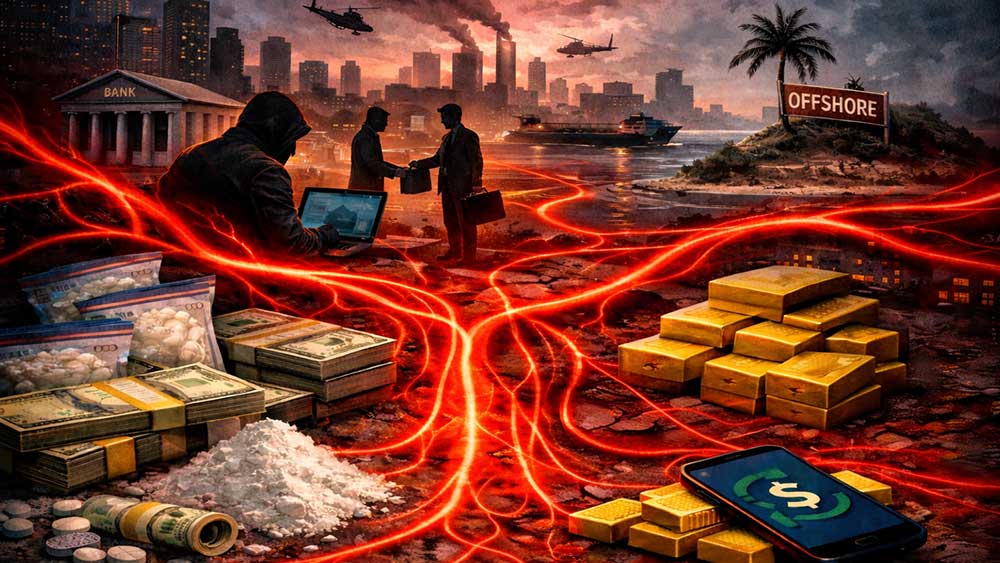
“The ultimate nexus between crime and commerce — a pipeline that launders billions through invisible trade.”
Beyond the headlines of cartel violence lies a more elusive beast: the invisible arteries that funnel drug money into the legal economy. This blog dives deeper, illuminating how illicit wealth hides in plain sight—through trade-based laundering systems, high-end real estate, and underground financial networks.
1. The Legacy Laundering Engine: The Black Market Peso Exchange (BMPE)
Since the 1980s, Colombian cartels have confronted a bizarre dilemma: too much cash. Dollars flooded their vaults from U.S. drug sales. Smuggling the money directly across borders became too risky, and traditional banking systems flagged large deposits.
Enter the Black Market Peso Exchange (BMPE)—an ingenious trade-based laundering system. Here’s how it works:
1.Cartels in the U.S. pass dollars to a peso broker.
2.The broker deposits the cash in U.S. banks through structured, small deposits to evade reporting laws.
3.In Colombia, importers receive peso equivalents and the broker uses the laundered dollars to pay U.S. exporters.
4.Goods are shipped, importers pay the broker in pesos, and the cycle repeats.
This system remains one of the Western Hemisphere’s most efficient laundering methods—estimated at $5 billion annually.
FinCEN.gov
PBS Financial Crime Academy
2. The Sophistication of Today’s Broker Networks
Modern brokers like “David” don’t just exchange currencies—they orchestrate multi-layered operations:
-
They negotiate steep discounts on drug dollars (sometimes 40% below official rates) to assume all logistical and legal risks.
-
Cash is physically delivered in bags, boxes, or even car trunks, then dispersed into hundreds of sub-$10,000 bank deposits.
-
Colombian importers end up paying for legitimate goods using laundered money.
Laredo Morning Times
Financial Crime Academy
3. Real Estate as a Laundering Canvas
Until recently, laundering through goods dominated the scene. Now, U.S. real estate is becoming the canvas of choice:
-
Investment firms like Sefira Capital have forfeited over $30 million after accepting BMPE-linked funds with no due diligence.
-
These transactions often involve special-purpose vehicles (SPVs), obscuring ownership and laundering vast sums with minimal scrutiny.
InSight Crime
4. New Frontiers: Chinese Underground Brokers & Fentanyl Cash
The laundering landscape has evolved. Chinese underground banks are now significant players, especially in funneling fentanyl profits:
-
Brokers collect U.S. drug cash and advertise it via apps like WeChat to Chinese clients who need U.S. dollars (often restricted by capital controls).
-
These brokers operate quickly—offering 1–2% commissions, far below traditional rates of 7–10%.
-
Investigations have traced $50 million in laundered funds tied to Chinese-Mexican networks and infrastructure facilitating multiple cash drops.
The Wall Street Journal
Financial Times
5. Defiance of Regulation, Persistence of Laundering
Even as financial systems tighten, laundering networks adapt:
-
FinCEN has issued advisories pointing to suspicious deposit patterns—multiple small deposits, dormant accounts, and foreign nationals opening several accounts simultaneously.
-
Trade-based laundering remains elusive because it blends seamlessly with legitimate commerce—solo exporters or importers don’t stand out unless flagged.
-
Countries like Argentina show a positive example: easing currency controls eliminated the “arbolitos” black-market exchange—proof that policy reform can disrupt informal markets.
FinCEN.gov+1
Reuters
Why This Matters: Money Laundering, Market Distortion, and Crime Infrastructure
| Stakeholder | How They Benefit from These Schemes |
| Cartels | Convert illicit cash safely, support operations, expand influence |
| Brokers | Control fund flows, assume risk, profit from large margins |
| Importers | Access cheaper dollars, undercut tax-paying competitors |
| Investors/Markets | Laundered investments distort economies, hide criminal gain |
When these systems operate unchecked, they distort markets, undermine trust, and fuel societal decay.
Final Word
From trade-based schemes like BMPE to high-tech underground brokers, drug money laundering is no sideshow—it’s a critical engine of illicit profit. It integrates crime with commerce so seamlessly that stopping it demands not just regulation, but smarter, adaptive, globally coordinated responses.
Disrupting one channel only spawns another—and without inventive solutions, laundering thrives in the shadows. The fight must be as agile as the criminals it targets.